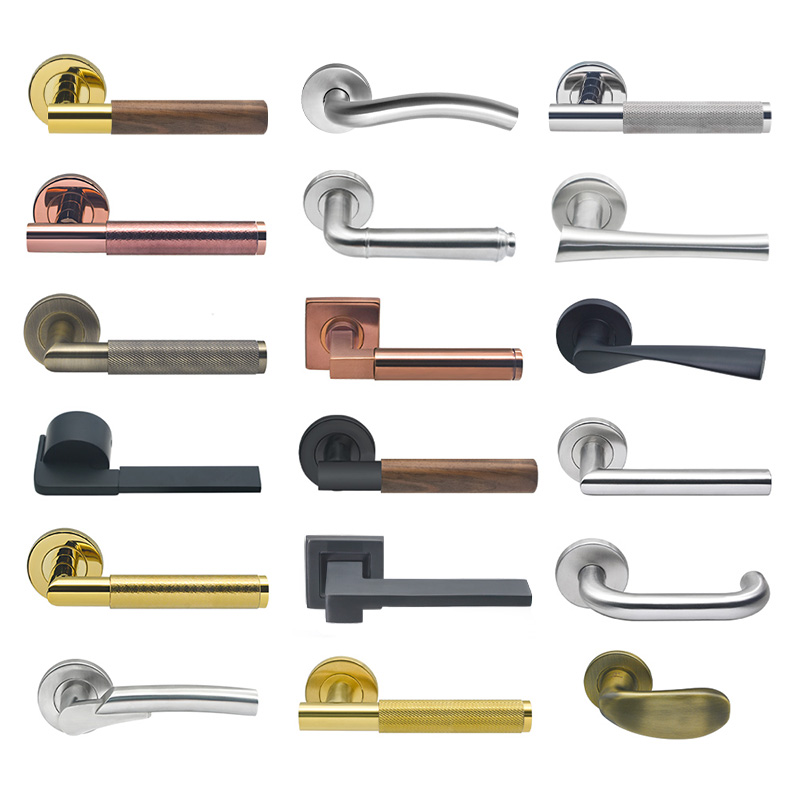
Top 6 Door Handle Suppliers In The USA

I Specified Hardware for 14 Multi-Family Builds in 2025 — Here Are the 6 US Door Handle Brands Actually Worth Their Lead Times

In November 2025, I was staring at a $14,000 change order for a boutique hotel project in Austin.

Here’s why. The “cost-effective” commercial door handles we’d specified from a no-name overseas vendor failed the local fire marshal’s ADA inspection (ICC A117.1 compliance issues), and half the internal return springs snapped within 60 days of installation. I had to rip out 120 levers and air-freight replacements at a punishing premium just to get our Certificate of Occupancy.

That disaster is why I rebuilt my entire approach to Division 8 architectural hardware.

If you’re sourcing commercial hardware in 2026 — where state security grants are eating up Grade 1 inventory and lead times for custom finishes are stretching past 14 weeks — guessing isn’t an option. You don’t need a list of 10 or 15 random companies pulled from a Google search. You need to know which manufacturers actually deliver on their spec sheets.

Here’s my field-tested take on the US door hardware manufacturers I trust to put on my commercial and high-end residential schedules.

A quick note on “Suppliers” vs. “Manufacturers”: If you call Schlage today and ask to buy 400 door handles, they’ll politely redirect you. B2B volume goes through contract hardware distributors (National Lock Supply, Quality Door, LaForce, etc.). But your distributor only sells what you specify. This guide ranks the manufacturers you should be writing into your project specs.

Who This Is For (And Who It Isn’t)

This is for:

  • Commercial architects and spec writers handling Division 8 hardware schedules
  • Procurement managers for multi-family, healthcare, and hospitality builds
  • High-end custom residential contractors who refuse to deal with callbacks

This is NOT for:

  • Homeowners shopping for a $25 front door knob at a big box store
  • Flippers trying to cut corners on a tight budget. If you want hollow zinc alloy that scratches in a week, Amazon has you covered.

My Methodology

I don’t evaluate door hardware by how shiny it looks in a PDF catalog. I evaluate it by how much pain it causes my installation crew and my project budget. Here’s my weighting system (and yes, the percentages are my own — your priorities may differ):

  1. Grade 1 ANSI/BHMA Verification (30%) — If a brand claims “commercial grade” but lacks actual BHMA certification for 1 million cycles, the spec sheet goes in the trash.
  2. Internal Mechanism Engineering (25%) — I take the chassis apart. Heavy-duty return springs? Solid retaining ring or a cheap C-clip? (More on this later.)
  3. Real-World Lead Times for Custom Finishes (20%) — Satin Chrome (626) is easy. But spec Matte Black or Oil-Rubbed Bronze and I want to know: are you holding up my project for 16 weeks?
  4. ADA / Code Compliance Friction (15%) — The exact measurement of the lever return toward the door face. Fire marshals fail doors over 1/16th of an inch.
  5. Access Control Integration (10%) — How cleanly the mechanical hardware mates with electrified strikes and card readers.

Quick Comparison Table: The 2026 Reality

Other lists give you marketing specs. Here’s my actual procurement data from Q3 2025 to Q1 2026.

BrandMy Primary Use CaseLead Time (Satin Chrome)Lead Time (Matte Black)Cost Per Grade 1 Lever (Project Pricing)Internal Material
Schlage (Allegion)High-traffic commercial, schools2-3 weeks8-10 weeks$185 – $240Forged brass / heavy steel
BaldwinLuxury hospitality, high-end resi4-6 weeks10-12 weeks$350 – $600+Solid forged brass
EmtekBoutique office, amenity spaces3-4 weeks4-5 weeks$120 – $190Brass / zinc (varies)
Sargent (ASSA)Healthcare, institutions4-5 weeks12+ weeks$210 – $280Heavy-duty steel/brass
DormakabaAccess control / electrified6-8 weeks14+ weeks$450 – $900 (w/ tech)Steel / aluminum
HagerBack-of-house hollow metal doors1-2 weeks6 weeks$135 – $160Cast zinc / steel

Pricing reflects what my distributors are quoting on project-volume orders. Walk-in retail will run 30-40% higher. Quotes lock for 15-30 days right now — more on that later.

The 6 Brands I Specify

1. Baldwin Hardware

Back to that $14,000 Austin hotel mistake. When we ripped out the failing overseas hardware, the client panicked and demanded something that would “never break again.” I called my distributor and specified the Baldwin Estate series.

Here’s what separates Baldwin from 90% of the market: weight.

When you hold a Baldwin lever in your hand, it feels like a weapon. That’s because they hot-forge solid brass instead of pouring molten zinc into a cast. Zinc is porous and brittle. Forged brass is dense and has a different acoustic signature when it strikes the latch — luxury clients notice this without being able to explain why.

When the replacements arrived on site, my lead installer picked one up and just nodded. The install went without hiccups. Their through-bolt system aligns the way the spec sheet says it will, and the internal tension springs are stiff enough to feel deliberate. Two years later, those doors see hundreds of daily cycles, cleaning chemicals, and luggage carts banging into them. Not a single finish has chipped. Not a single lever sags.

Field Notes:

  • The Estate vs. Reserve trap. Baldwin has tiers, and they aren’t equivalent. The Estate line is their true custom-forged solid brass heavy-hitter. Reserve and Prestige are lighter and built to compete at lower price points. For commercial hospitality, I write Estate into the spec — explicitly, with the model number — to prevent any value-engineering swap-outs.
  • Finish longevity. Their Lifetime PVD (Physical Vapor Deposition) finish has held up against coastal salt air better than I expected. I used it on a beachfront property in Miami; three years later, it still looks factory-new.
  • The weight test. An average commercial lever set weighs about 2.5 lbs. A Baldwin Estate set is closer to 4.5 lbs.

Honest caveat: I haven’t put Baldwin through a true high-volume institutional test (think: 10,000+ daily cycles in a school). For that environment, I’d still default to Schlage or Sargent. Baldwin is built for hospitality and luxury residential — that’s where it shines.

2. Hager Companies

If Baldwin is the tuxedo, Hager is the steel-toed work boot.

To explain why I keep coming back to Hager, here’s a conversation I had with Mike, a master carpenter who has hung over 10,000 commercial doors for my firm:

Me: “Mike, we’re doing a logistics facility in Dallas. 150 interior hollow metal doors. Electrical rooms, janitorial closets, stairwell exits. Spec Schlage NDs across the board?”

Mike: “Don’t waste the client’s money. Spec Hager 3400 Series.”

Me: “Going to hold up to warehouse guys kicking the doors open?”

Mike: “I’ve been putting Hager on back-of-house since 2012. The chassis is a brick. They aren’t pretty, but they align in standard 161 door preps without a fight. Plus, their installation instructions aren’t written in hieroglyphics.”

Me: “What’s the catch?”

Mike: “The lever designs that look halfway decent? You can count them on one hand. Put Hager on the main lobby and your interior designer will murder you. Stairwells and maintenance closets only.”

Mike was right. I pulled the pricing. Schlage NDs were quoting around $215 for this specific function. Hager 3400 Series came in at $142. Across 150 utility doors, we saved the client over $10,000 — without sacrificing life-safety code compliance.

What the Spec Sheet Won’t Tell You:

  • The Division 8 secret weapon. Hager isn’t a glamorous consumer brand, but they’re a B2B workhorse. They make hinges, closers, thresholds, and handles, and bundling these together usually unlocks a deeper distributor discount than buying piecemeal.
  • Aesthetic ceiling. You’re getting standard tubular commercial levers. That’s it. Don’t try to dress them up for client-facing amenity areas.
  • Forgiving tolerances. Hager hardware handles slightly misaligned door frames better than tighter-tolerance luxury brands. If your drywallers rushed the frames, Hager latches usually still catch. Baldwin won’t.

3. Schlage (Allegion)

The US commercial door hardware market is mid-shift right now.

According to my 2025/2026 procurement data — and confirmed by recent industry supply chain reports — we’re in the middle of a Grade 1 retrofit cycle. Schools, hospitals, and municipal buildings are burning through state security grants to upgrade locks to “classroom intruder” functions. That demand is rewriting lead times.

I ran an audit on our purchasing over the last 18 months. Schlage (specifically the ND Series) accounted for 62% of our commercial specs. Here’s what the numbers showed:

  • Defect rate: Out of 1,240 Schlage ND Series levers we installed in 2025, we had 3 warranty claims. That’s a failure rate of 0.24%.
  • Lead time creep: In 2024, I could get Schlage NDs in Satin Chrome (626) in 10 days. By January 2026, the school retrofit wave pushed that to 28 days.
  • The finish premium: Specifying dark bronze or matte black doesn’t just add 4-6 weeks to lead time. It adds an average of 18% to unit cost at the distributor level.

Schlage is the default heavyweight for institutional hardware, and the ND Series earns its reputation. Their Vandlgard option — where the outside lever spins freely when locked, so it can’t be snapped off by someone standing on it — is a must for public-facing doors.

A mild contrarian take, though: I think Schlage gets over-specified. Half the time I see Schlage NDs on a schedule, the doors don’t actually need that grade of abuse tolerance. Hager would do the job for 35% less. Specifiers reach for Schlage as a CYA move, and clients foot the bill.

Watch For:

  • The ALX vs. ND distinction. Schlage pushes the ALX series (Grade 2) as a modular cost-saving option. I ban it from commercial projects. The internal chassis is noticeably lighter. Pay the extra ~$40 for the ND Series (Grade 1) and move on.
  • Keying systems. If your client has an existing Everest 29 restricted keyway system, you’re locked into the Allegion ecosystem. Schlage cylinder integration is smooth in that scenario — painful if you’re trying to leave it.
  • The 2026 supply chain reality. Don’t wait to order classroom-intruder functions (Schlage ND95). State-funded school upgrades have wiped out national warehouse inventory. I’m seeing 8-week minimums on large orders.

4. Sargent (ASSA ABLOY)

On a healthcare facility build in Colorado, the architect specified Corbin Russwin, but the facility management team demanded Sargent. Both are owned by ASSA ABLOY, so I figured the FM team was playing favorites. I decided to settle it in our mockup room.

I mounted a Corbin Russwin CL3300 and a Sargent 10X Line on two identical solid-core wood doors.

First test: vertical load. Simulating a heavy backpack hanging on the lever, or a frustrated hospital cart pusher slamming down on it. The Corbin handled it well. The Sargent 10X barely registered the weight. The 10X uses an over-engineered internal spring cartridge — you can feel it the moment you depress the lever.

Second test: ADA return. In hospitals, catching clothing or IV lines on door levers is a real safety risk, not a theoretical one. The Sargent lever sloped back toward the door face with a tighter tolerance — less than 1/4 inch of gap — effectively eliminating the snag hazard.

Sargent won the test, and they won the project. The FM team wasn’t playing favorites. They knew something I didn’t.

Where Sargent Earns the Premium:

  • The 10X line’s hidden benefit. The 10X series is forgiving during install. It accommodates doors from 1-3/4″ to 2-1/4″ thick without special spindles or adapters. Saves installers real hours on the floor.
  • Microshield coating. For healthcare, Sargent offers a silver-based antimicrobial coating. Other brands have similar tech, but Sargent’s seems to hold up better against aggressive industrial bleach cleaning protocols without clouding. (Caveat: this is based on field observation, not lab testing.)
  • The price penalty. A Sargent Grade 1 mortise lock costs my clients 12-15% more than the Schlage equivalent. Worth it for healthcare and institutions. Hard to justify for general commercial.

5. Emtek

Spend five minutes with a veteran commercial locksmith and you’ll hear the same complaint about Emtek.

Let me be clear first: Emtek makes beautiful hardware. We use them constantly for luxury apartment amenity areas, boutique leasing offices, and high-end residential. Their ability to mix-and-match a knurled brass lever with a matte black backplate, straight from the factory, is unmatched at this price point.

But here’s the insider piece most designers don’t know: the C-clip vulnerability.

Inside many of Emtek’s tubular locksets, the lever is held to the internal chassis by a small metal “C-clip” retaining ring. If a user yanks the handle horizontally, or if the door binds and someone uses body weight to pull it open, that C-clip can pop off or deform. Once it fails, the lever falls off in your hand.

I know because my maintenance teams have repaired them. Multiple times.

So I have a strict internal rule for Emtek: visual impact areas only, low abuse.

I put Emtek on the leasing office conference room. I put it on the luxury penthouse bathrooms. I never put it on the main public restroom door. I never put it on a heavy exterior entry that catches wind gusts.

The Insider Stuff:

  • Parent company leverage. Emtek is owned by ASSA ABLOY, which means they actually have working distribution networks. Custom configurations in 3-4 weeks is fast for bespoke hardware.
  • The spring cassette. Unlike cheap Amazon hardware, Emtek uses an independent spring cassette behind the rosette. The lever doesn’t rely on the latch itself to spring back to horizontal — which prevents “droopy handle” syndrome you see on knockoffs.
  • Finish inconsistency. Because they offer so many custom combinations, their “Unlacquered Brass” patinas at wildly different rates depending on the climate. Warn your clients up front, or you’ll be on the phone explaining why their “matching” hardware no longer matches.

6. Dormakaba

I like to think I’m immune to amateur mistakes. In Q2 2025, Dormakaba handed me a brutal lesson in electrified hardware integration.

We were retrofitting a 40-story commercial high-rise in Chicago, transitioning to a mobile-credential access control system. I specified Dormakaba’s wireless electronic door handles for 80 suite entries. Sleek, secure, and they eliminate the need to core-drill doors to run wires.

Here’s where I failed: I didn’t account for the building’s physical environment.

The walls around the doors had unusually heavy steel reinforcement. Once installed, the Dormakaba wireless locks couldn’t communicate reliably with the hubs we’d mounted in the ceilings. The steel was creating a Faraday cage effect.

We spent $8,500 moving the communication hubs closer to the doors and pushing a firmware update to all 80 locks to adjust their ping frequency.

Dormakaba’s hardware wasn’t at fault. My environmental assessment was. When Dormakaba is deployed correctly, their electronic locks are the standard for hospitality and enterprise commercial. Their mechanical construction is genuinely vault-grade.

Lessons I Paid For:

  • Standalone battery reality. If you spec wireless locks, the facility management team is now in the battery replacement business. Dormakaba uses standard AAs, but replacing them across 400 doors annually is a real labor cost. Build it into the OPEX model before the client signs off.
  • Audit trail depth. Their electronic hardware stores thousands of access events locally. If the network goes down, the handle still works, still records who entered, and uploads the audit trail when the network returns.
  • Mechanical overrides. Always — always — spec their locks with a concealed mechanical key override. If the electronics fry during a power surge, you don’t want to be drilling out a $900 lockset at 11 PM.

Brands I Removed From My List

Two brands show up on every other “best of” list on the internet. I refuse to specify either of them for commercial or high-end residential.

1. Kwikset. Kwikset is a residential brand. Full stop. They market their “SmartKey” technology and their commercial-adjacent lines aggressively, but the internal tolerances are loose. Die-cast zinc components wear down fast under commercial traffic. If I see Kwikset on a commercial door schedule, I assume the contractor is burying cost-cutting in the details — and I start asking other questions.

2. Generic / white-label “direct to consumer” brands. There’s a plague of beautifully photographed matte-black door handles flooding online ads right now. They cost $45. They’re hollow, the finish is painted (not powder-coated or electroplated), and they lack UL fire ratings. Putting these on a commercial building is a liability. If there’s a fire and the plastic internal components melt, trapping someone in a room? You will be sued into oblivion.

Real Cost Breakdown

To prove I’m not just reading marketing brochures, here’s a blind cost analysis from a recent bid package — a 200-unit mixed-use development.

The scenario: Standard Classroom Function (key outside locks/unlocks lever; inside always free). 1-3/4″ wood door. Satin Chrome (626) finish.

  • Utility option (Hager 3400 Series): $145.00 per unit
  • Standard commercial option (Schlage ND Series): $218.00 per unit
  • Institutional heavy-duty (Sargent 10X): $255.00 per unit
  • Luxury aesthetic (Baldwin Estate): $410.00 per unit

The volatility warning: Don’t delay your hardware tenders in 2026. As Xeneta’s recent supply chain reports flagged, delaying tenders to time the market is backfiring. Raw material costs (brass and heavy steel especially) are fluctuating week to week. A distributor quote today is usually only valid for 15 to 30 days. Lock in your specs early.

The Verification Checklist I Use

Before I finalize any door hardware schedule, I run it through this. (I have it as a one-page PDF that my junior spec writers have to sign off on.)

  1. Fire check. Does the door require a fire rating? If yes, is the specific handle function UL-listed for 3 hours? Never assume all handles from a brand are fire-rated — they aren’t.
  2. ADA check. Does the lever return to within 1/2 inch of the door face? (ICC A117.1 standard.)
  3. Wind-storm check. Is this exterior hardware in Florida or the Gulf Coast? Does it carry Miami-Dade NOA impact ratings?
  4. Strike plate check. Did the door frame manufacturer prep for a standard 4-7/8″ ASA strike, or a residential T-strike? Mismatched strikes cause about half of installation delays I’ve seen.
  5. Handing check. Are the levers handed (left or right)? Order 50 left-handed Emtek levers for right-handed doors and you’re going to have

FAQ (From Real B2B Buyers)

Can I use residential Grade 2 hardware on light commercial projects to save money?

I’d push back hard on this. Aside from the fact that it’ll break within two years, it’s a liability exposure. If an ADA-mandated accessibility lever snaps off and someone is injured, your insurance carrier will check whether you installed commercial-grade (Grade 1) hardware. The savings are not worth the document trail.

Why are matte black commercial finishes taking 10-14 weeks right now?

Matte black (usually finish code 622) requires a powder coating process that many legacy manufacturers still batch-run. Unlike Satin Chrome — which runs constantly — they wait until they have enough matte black orders to justify changing the factory line. Order early. Or accept the delay and plan around it.

Emtek vs. Baldwin: which is actually better?

They’re built for different jobs. Want modern, highly customized aesthetics (think a clear acrylic lever on a black brass backplate), low-abuse environment? Emtek. Want heavy, traditional, bomb-proof solid brass that will outlive the building? Baldwin.

How do I navigate the 2026 Grade 1 hardware shortage?

State-funded school security upgrades are eating inventory. If you need Schlage ND or Sargent 10X locks, approve the hardware submittals the moment the architect issues them. Don’t wait until the drywall is up to order hardware — that used to work in 2022. It doesn’t anymore.

What does “classroom intruder function” actually mean?

It’s the most-requested function right now. It allows a teacher (or office worker) to lock the outside handle from the inside using a key, without having to open the door and step into the hallway during an active threat. The inside lever stays unlocked for free egress. That’s the whole design.

Closing

Door hardware is the most tactile element of any building you’ll ever ship. It’s the first thing your client touches when they walk in. It’s the last thing they touch on the way out. And it’s the one component on the schedule that subcontractors will quietly substitute to pad their margins if you let them.

Don’t let them.

Here’s what I’d do tomorrow morning if I were starting a new commercial or high-end residential build: pull the architectural floor plans, mark every door as either high-abuse or high-visibility (some are both), and call a contract hardware distributor — not a sales rep, an actual distributor — and request physical samples of Schlage ND and Baldwin Estate levers.

Put them in your hands. Feel the weight difference. The Schlage will feel like a tool. The Baldwin will feel like a piece of equipment that cost too much. Both feelings are correct.

Then write the spec, model numbers and all, and refuse to negotiate on the substantive line items. The matte black can wait 10 weeks. The lawsuit from a failed ADA lever can’t.

Last updated: May 2026. I revisit this list every 90 days as lead times shift. If you’ve had a different experience with any of these brands — especially in regions I don’t work in — I want to hear it.

Hey There, I am Lisa

I’m Lisa from doorhandlesupplier.com. We are a professional cabinet handle manufacturer. Get an instant quote for your projects now!

Get Door Handles Quotation Now

Tell us what you need — we’ll get back with expert advice, pricing, and lead time.